

If you’ve spent any time on TikTok or Twitter lately, you’ve probably run into people asking the same question: what in the world does shee foo mean? Maybe you heard it in a show, saw it in a comment section, or watched a friend try to say it and get it slightly wrong. Either way, you’re not alone, and you’re about to get the full, no-fluff answer.
This little phrase has quietly turned into one of the more searched Arabic expressions in English-speaking corners of the internet. A lot of that traces back to one specific Netflix show. But the phrase itself has been around for generations, long before any streaming platform picked it up. Let’s break it all down.
What “Shee Foo” Means
Here’s the short version, for anyone who just wants the answer and doesn’t need the whole backstory.
Shee foo is a colloquial Arabic phrase that roughly means “that thing” or “that specific one.” It’s used to point at something particular without actually naming it, kind of like when you snap your fingers and say “you know, that thing” in English because the word just isn’t coming to you.
| Quick Fact | Detail |
|---|---|
| Language | Colloquial Arabic (spoken, not formal) |
| Dialect group | Levantine Arabic |
| Regions where it’s used | Palestine, Lebanon, Jordan, Syria |
| Popularized by | Netflix series Mo, starring Mo Amer |
| Literal translation | “thing” + a pointing marker |
| Closest English equivalent | “That thing,” “that one,” “you know what I mean” |
| Offensive? | No — completely neutral |
Now let’s get into the actual substance.
What Does Shee Foo Mean? (Literal and Practical Breakdown)

To really understand shee foo meaning, it helps to split the phrase into its two working parts. Neither word is complicated on its own. It’s the combination that gives it its function.
The Literal Parts — “Shee” and “Foo”
Shee comes from the Arabic word for “thing” or “object.” It’s a general noun, similar to how English speakers use “stuff” or “thing” when they don’t want to (or can’t) name something specific.
Foo works differently. It’s not a noun at all — it’s a colloquial pointing marker. Think of it as functioning the way “that one” or “this specific one” functions in English. On its own, it doesn’t mean much. Paired with “shee,” it turns a vague noun into something definite.
What It Means in Actual Use
Put the two together, and shee foo becomes a way of saying “that particular thing” or “that specific item,” without you having to actually name what the thing is. Maybe you forgot the word. Perchance it’s obvious from context. Maybe naming it directly would just take too long. Either way, shee foo does the pointing for you.
Here’s a simple analogy: imagine you’re cooking with someone and you say, “hand me the thingy,” while gesturing at a spatula. You didn’t say “spatula.” You didn’t need to. Context did the heavy lifting. That’s basically the job shee foo performs in Arabic conversation.
Closest English Equivalents
If you’re trying to map this onto English, here are the phrases that land closest:
- “That thing”
- “That one, you know the one”
- “That specific item”
- “The thingy” (informal American English)
- “You know what I mean” (when used to trail off a description)
None of these are a perfect one-to-one match, because that’s how idioms work across languages. But they get you close enough to use the phrase with real understanding, not just memorization.
Is It “Shee Foo,” “She Foo,” or “See Foo”? Clearing Up the Spelling Confusion
Here’s something almost nobody explains clearly: there is no official English spelling for this phrase. That’s not a flaw in anyone’s writing — it’s just how transliteration works.
Why There’s No Fixed English Spelling
Shee foo is a colloquial Arabic expression, spoken and passed down in everyday conversation rather than written down in textbooks. When a spoken phrase gets transliterated into English letters, spelling becomes a matter of “however it sounds to you,” not a fixed rule. That’s why you’ll see it written multiple ways online, and all of them are trying to represent the exact same sound.
The Most Common Search Variants
If you’ve searched any of these, you were looking for the same thing:
- shee foo (the most common spelling)
- what does she foo mean (dropped double “e”)
- see foo (phonetic simplification)
- shee fou
- shi foo
All of these point to one underlying Arabic sound. So if you’ve seen the phrase spelled a different way somewhere else, don’t worry — you’re not missing some separate expression. It’s the same one.
Quick tip: When you’re not sure how to spell a transliterated phrase, search using the sound rather than a specific spelling. Arabic-to-English transliteration rarely has just one “correct” answer.
Where the Phrase Comes From: Levantine Arabic Explained
To really get shee foo meaning arabic, you need a little background on the dialect family it belongs to.
What “Levantine Arabic” Actually Covers
Levantine Arabic is a regional dialect group spoken across Palestine, Lebanon, Jordan, and Syria. It’s not one single uniform way of speaking — each country and even each city has its own flavor — but the dialects share enough vocabulary, rhythm, and grammar that speakers across the region generally understand each other easily.
This dialect family is known for being expressive and musical. It leans heavily on tone, gesture, and context, which is exactly why phrases like shee foo work so naturally within it. The phrase isn’t really about the words themselves — it’s about the shared understanding between speaker and listener.
How It Differs From Modern Standard Arabic
A lot of people assume “Arabic” is one single language everywhere. In reality, there’s a big gap between the formal written language and the way people actually talk day to day.
| Feature | Modern Standard Arabic (MSA) | Levantine Arabic |
|---|---|---|
| Used in | News, books, official documents | Everyday conversation |
| Learned through | Formal education | Home, community, daily life |
| Flexibility | Rigid grammar rules | Loose, conversational structure |
| Regional variation | Mostly uniform | Varies by country and city |
| Contains phrases like “shee foo”? | No | Yes |
That’s the key point: shee foo would never show up in a formal Arabic news broadcast or a textbook. It lives entirely in casual, spoken Palestinian Arabic and its neighboring dialects.
Why Colloquial Phrases Rarely Appear in Formal Arabic
Formal Arabic prizes precision. Every word tends to have a specific, named meaning. Colloquial dialects, on the other hand, thrive on shortcuts, shared context, and phrases that lean on tone and gesture rather than exact definitions. Shee foo is a perfect example of that shortcut culture — it exists specifically because naming things directly, every single time, isn’t how real conversation flows.
How to Pronounce Shee Foo Correctly
Good news here: the shee foo pronunciation is genuinely approachable, even for people who’ve never studied Arabic.
Syllable-by-Syllable Guide
- Shee — sounds close to the English word “she,” held just slightly longer than usual.
- Foo — rhymes with “blue” or “moo.”
Put together, it flows as one relaxed phrase: shee-foo, spoken smoothly rather than as two separate, clipped words.
Common Mispronunciations
Non-native speakers often make one of these small mistakes:
- Clipping “shee” too short, so it sounds like “shih” instead of “she.”
- Over-pronouncing “foo” with a hard, sharp ending instead of a soft, rounded one.
- Pausing between the two syllables instead of letting them blend together.
None of these mistakes are embarrassing — they’re just the natural result of a sound pattern that doesn’t map perfectly onto English. Practice saying it quickly and casually, the way you’d say “y’know” in English, and you’ll get close.
A Simple Comparison
Think of two familiar English words mashed together: “she” plus “blue,” minus the “bl.” Say them fast, back to back, and you’re basically there.
The Netflix Show Mo: Where the Phrase Blew Up
The reason so many people are searching for this phrase right now comes down to one show: Netflix series Mo.
Quick Context on the Show and Mo Amer
Mo is loosely based on the life of comedian Mo Amer, and it follows a Palestinian American character navigating identity, family, and daily life with a mix of humor and honesty. The show has been praised for its authenticity, and a big part of that authenticity comes from the dialogue itself.
How the Phrase Appears in Dialogue
Instead of simplifying the Arabic for English-speaking viewers, Mo lets characters speak the way real Palestinian families actually speak at home. Shee foo shows up naturally in conversation, exactly the way it would in a real household, with no subtitle explaining what it means and no character pausing to define it.
Why Unexplained Slang Drove Curiosity
Here’s the interesting part: leaving the phrase unexplained is exactly what made it spread. If the show had stopped to translate it, viewers would’ve moved on without a second thought. Instead, curious viewers heard something unfamiliar, felt intrigued rather than confused, and went straight to their search bars. That’s a pattern worth remembering — mystery drives searches way more than exposition does.
The Scene Everyone’s Talking About — The Comedic Mix-Up Explained
Beyond the general use of the phrase, one specific scene did a lot of heavy lifting for the show’s viral moment.
What Actually Happens in the Scene
In an early episode, a side character who speaks broken English uses a phrase that sounds very close to shee foo as an all-purpose response. He believes it means “yes” in English. In reality, the phrase he’s actually saying carries a completely different, unrelated meaning in Arabic.
The Real Confusion, Explained
This is where a lot of viewers get tripped up. The character’s mistaken interpretation is not the “real” translation of shee foo — it’s a joke built on the character mixing up two similar-sounding expressions. The show is playing with the gap between how something sounds and what it actually means, which is a very real experience for anyone who’s ever mixed up two words in a second language.
Why the Joke Lands With Multilingual Audiences
“It felt warm rather than mean-spirited,” is how a lot of viewers described the moment — and that’s really the key to why it worked.
The humor doesn’t come from mocking the character. It comes from recognition. Anyone who’s grown up speaking two languages, or learned a second language as an adult, has had a moment exactly like this: confidently using a word or phrase that means something completely different than you think it does. That shared, slightly embarrassing experience is what made the scene resonate so widely.
How “Shee Foo” Took Over Social Media
Once the show planted the seed, the internet did what it always does with an intriguing, unexplained phrase — it ran with it.
Short-Form Video Breakdowns
Short videos explaining the Arabic meaning of shee foo started gathering serious attention. Creators broke down the pronunciation, the literal translation, and the cultural context, often stitching or duetting clips from the show itself.
Forum and Discussion Threads
Language-learning forums and television discussion boards both became gathering spots for people trying to sort fact from fiction. Native Arabic speakers stepped in regularly to clarify the real meaning, especially once the comedic mix-up scene started causing confusion.
How Arab American Users Reclaimed It
Social media captions started using shee foo playfully, especially among Arab American users, as a lighthearted nod to the show and to shared cultural experience. It became a kind of inside joke that doubled as cultural pride.
The Meme-to-Identity Pipeline
Here’s the bigger pattern worth noticing: a phrase moves from show, to meme, to identity marker, in a pretty predictable arc.
- A phrase appears naturally in authentic dialogue.
- Viewers unfamiliar with it search for meaning.
- Explainer content spreads the definition further.
- Communities connected to the language adopt it as a shared, playful reference.
- It becomes loosely tied to broader conversations about identity and culture.
Shee foo followed this exact path, ending up loosely connected to wider conversations about Palestinian identity and the expressiveness of Levantine Arabic as a whole.
Similar Phrases in Levantine Arabic (A Mini Phrasebook)
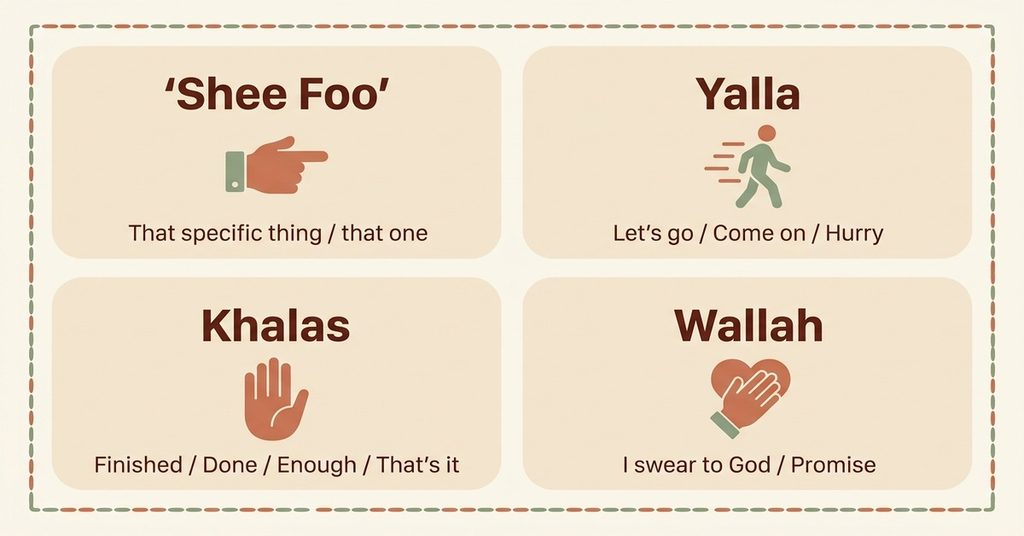
Since shee foo isn’t the only pointer-style phrase in casual Arabic, here’s a small phrasebook of related expressions that work in similar situations.
| Phrase (transliterated) | Rough Meaning | When You’d Use It |
|---|---|---|
| Shee foo | “That specific thing” | Pointing to something without naming it |
| Ha shee | “This thing” | Referring to something nearby |
| Wallah | “I swear / seriously” | Emphasizing sincerity |
| Yalla | “Let’s go / hurry up” | Prompting action or urging someone along |
| Khalas | “Enough / done” | Ending a topic or action |
These phrases all share a common trait: they lean on shared context and tone rather than strict, dictionary-style definitions. That’s the heartbeat of colloquial Arabic in general — it’s built for real conversation, not formal precision.
When (and When Not) to Use Shee Foo
If you want to actually use the phrase, a few simple guidelines will keep you on solid ground.
Natural, Casual Use Cases
- Pointing toward a specific object you can see but haven’t named
- Asking about a particular item without spelling it out
- Referencing something specific that already came up earlier in the conversation
Contexts Where It Doesn’t Fit
- Formal or academic writing
- Professional or written correspondence
- Describing something broad, vague, or general (its entire function is specificity, so using it for vague ideas defeats the purpose)
A Note on Using It Respectfully
Non-Arabic speakers can absolutely use the phrase casually, especially with Arabic speaking friends who tend to appreciate genuine curiosity about their language. The key distinction is intent: using it out of real interest lands very differently than using it as a punchline or mockery.
Common Misconceptions, Debunked
A handful of misunderstandings keep circulating, so let’s clear them up directly.
Misconception: It’s rude or offensive.
Reality: it’s a completely neutral, everyday expression with no offensive meaning whatsoever.
Misconception: It belongs exclusively to Palestinian Arabic.
Reality: while it carries an especially natural feel in Palestinian Arabic, it’s understood broadly across the wider Levantine region, including Lebanon, Jordan, and Syria.
Misconception: The Netflix scene reveals its true meaning.
Reality: the show’s comedic scene involves a character confusing shee foo with a different, similar-sounding phrase. That mix-up is the joke — it’s not an accurate translation.
Why TV Shows Keep Making Slang Go Viral
This isn’t the first time a streaming show has sent people scrambling to Google a foreign phrase, and it certainly won’t be the last. Authentic, unexplained dialogue on major platforms consistently sparks this exact kind of curiosity, because audiences respond to language that feels lived-in rather than translated for their benefit. When a show trusts its audience enough to skip the subtitle explanation, it invites genuine engagement instead of passive viewing — and that’s a pattern likely to keep repeating as more culturally specific stories find global audiences.
Frequently Asked Questions
What does shee foo mean in Arabic?
It means “something specific” or “that particular thing,” used to point toward a definite object or topic in casual conversation.
What does she foo mean?
This is simply a common spelling variation of shee foo — same phrase, same meaning, just a different way of writing the sound in English.
Is shee foo Palestinian specifically?
It carries an especially natural feel in Palestinian Arabic, but it’s understood and used across the broader Levantine Arabic region.
Why did shee foo go viral?
It gained attention after appearing naturally in the Netflix series Mo, especially following a comedic scene involving a character’s mistaken interpretation of a similar-sounding phrase.
Is shee foo offensive?
No. It’s a neutral, everyday colloquial phrase with no offensive meaning in Arabic.
How do you pronounce shee foo?
“Shee” sounds like the English word “she,” held slightly longer. “Foo” rhymes with “blue” or “moo.” Spoken together, they flow as one relaxed phrase.
Final Thoughts
Shee foo is a simple, flexible piece of everyday Arabic that points toward something specific rather than something vague. Its recent surge in popularity comes largely from an authentic, well-loved television show that introduced casual Arabic dialogue to a much wider audience than it’s ever had before.
Understanding both its real meaning and the comedic scene that sparked all the online curiosity gives the phrase its full context. In the end, it’s a small piece of language that ties together culture, identity, and a shared moment of television humor — proof that sometimes the smallest phrases carry the most interesting stories.

Eddie Brock is an experienced blogger and the creative voice behind Phrase Nook. With a passion for words, ideas, and engaging storytelling, he brings thoughtful perspectives and practical insights to every post. Eddie enjoys exploring diverse topics, connecting with readers, and turning everyday experiences into meaningful stories. His writing aims to inform, inspire, and keep readers coming back for more.