
You scroll past a comment, a caption, or an anime thread and spot “NTR.” Is it a joke? A warning label? Something you should have known already?
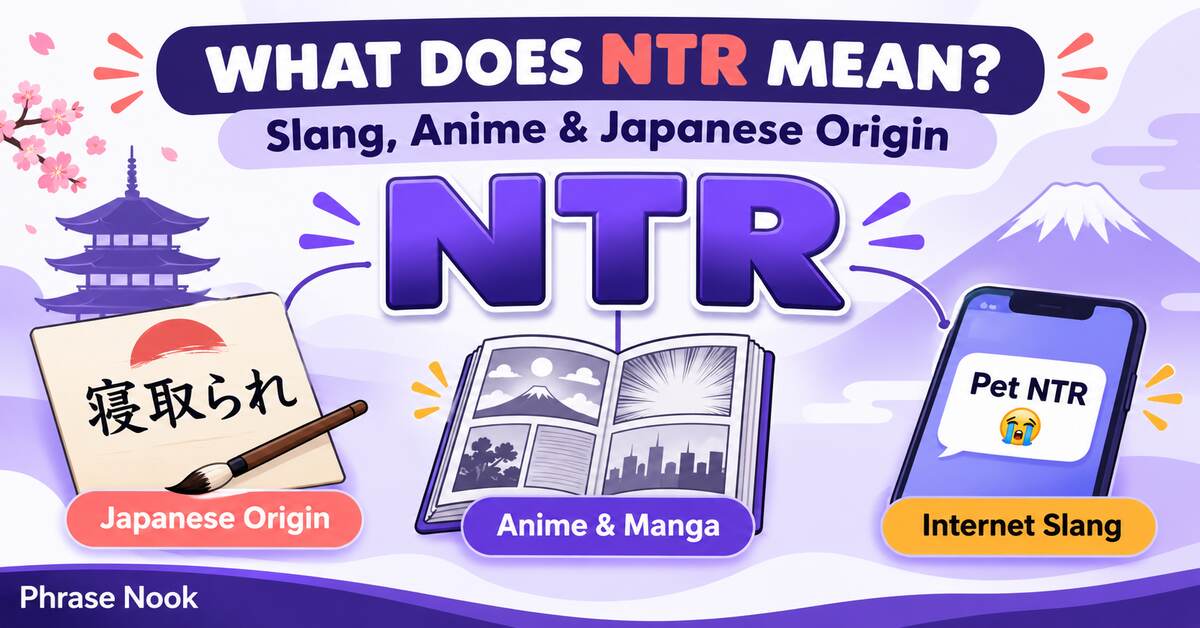
Here’s the short version. NTR is short for netorare (寝取られ), a Japanese term for having your partner taken by someone else. It started as a label for a story genre in anime, manga, and games. Over time, internet users stretched it into slang for any moment when someone feels replaced.
This guide walks through what NTR means in Japanese, in anime and manga, in text and chat, and in real relationships. Along the way you’ll see where the NTR meaning gets murky and where it doesn’t.
What Does NTR Mean? (Quick Answer)

NTR = Netorare (寝取られ). A Japanese word for a situation where someone’s romantic partner is taken away by a third person. In fiction, it names a genre. Online, it often works as a dramatic joke about being replaced.
Three things sum up the NTR meaning:
- The origin: a Japanese word borrowed whole into English fandom.
- The genre: a storytelling category built on romantic betrayal, jealousy, and loss.
- The meme: a flexible label people now use for pets, friends, and gaming teammates.
You’ll also see NTR mean unrelated things, like a famous Indian actor. We’ll cover that below.
Here’s how the three layers compare:
| Layer | Where you see it | Tone | Example |
|---|---|---|---|
| Japanese term | Dictionaries, language discussions | Neutral, descriptive | Netorare as a word meaning “being cuckolded” |
| Story genre | Manga sites, visual novel stores, anime forums | Serious, content-warning style | “Does this series have NTR?” |
| Internet slang | TikTok, X, Discord, group chats | Joking, dramatic | “My cat likes my roommate now. NTR.” |
What Does NTR Mean in Japanese?

Everything starts here, so let’s get the Japanese origin right.
Netorare, Broken Down
The word 寝取られ (netorare) comes from a verb. According to Wiktionary’s entry for 寝取る, netoru combines 寝 (ne, “sleep”) with 取る (toru, “to steal” or “to take”). In everyday use, it means taking another person’s spouse or lover.
Many articles say the word means “taken while you slept.” That’s a loose reading of the kanji. The sleep character here carries the sense of sleeping together. It doesn’t describe someone napping while a partner wanders off.
| Part | Japanese | Romaji | Meaning |
|---|---|---|---|
| Base verb | 寝取る | netoru | To steal someone’s partner |
| Passive form | 寝取られる / 寝取られ | netorareru / netorare | To have your partner stolen |
| Noun stem | 寝取り | netori | The act of stealing a partner |
| Causative form | 寝取らせる | netoraseru | To let or arrange for it to happen |
The “-rare” ending is the key. It’s a passive form, so the word puts you in the shoes of the person who lost someone.
The abbreviation NTR simply uses the first letters of the romanized word: NeToRare. English-speaking fans kept the Japanese word and shortened it, much like people shorten other loanwords.
Netori, Netoru, and Netorase
Three related terms often appear in fan discussions:
- Netorare: the viewpoint of the person who gets betrayed.
- Netori: the viewpoint of the person who does the taking. Wiktionary lists it as a genre label where a protagonist takes someone else’s love interest.
- Netorase: a variation where a person wants or allows their partner to be with someone else. A game developer explaining these terms on Patreon describes -rase as the “let someone do something” ending.
This matters because the perspective decides how a story feels. In a netorare story, you feel the loss. In a netori story, you don’t.
Why English Never Translated It
English has words that come close: “cheating,” “infidelity,” and “cuckold.” Dictionary.com’s pop culture entry notes that translations like “cuckold” show how the genre centers on the feelings of the person who got cheated on. None of those words capture that exact focus.
So fans kept the Japanese word. It names a specific narrative dynamic, not just an act.
What Does NTR Mean in Anime and Manga?
Now for the NTR meaning in anime and manga.
NTR as a Story Genre
In Japanese pop culture, NTR works as a genre tag. You’ll find it on manga sites, visual novel storefronts, and fan databases. A typical NTR story has three parts:
- A couple or a close bond.
- A third party who enters that bond.
- A story told mostly from the viewpoint of the person left behind.
The emotional core is jealousy, heartbreak, and emotional distress. Plot twists, action, and comedy take a back seat. Dictionary.com points to the 2010 two-episode Triangle Blue as a frequently cited example of the style.
Keep one point in mind: the genre targets adult audiences. Most NTR-tagged work falls under adult content, though the same theme can show up in tamer forms.
Whose Perspective? (Why Fans Label It Differently)
Fans argue over what “counts” as NTR, and perspective drives most of those fights.
If the story makes you sympathize with the betrayed person, fans usually call it NTR. If the story follows the person doing the taking, many fans call it netori instead. That’s why a love triangle in a school romance rarely gets the NTR tag. The story doesn’t center on loss and pain.
Some fans stretch the term further. One fan explanation on MyAnimeList argues the theme isn’t limited to spouses. It can cover any deep bond that a third party severs, even unrequited love. Others disagree and keep the label for romantic partners. Expect these debates to continue.
Content Warnings and Tagging in Fan Spaces
Fans ask “does this have NTR?” for a practical reason. They want to avoid it, or they want to find it. Tags appear in several places:
- Manga and visual novel databases: as formal tags.
- Discord servers: as spoiler or content-warning labels.
- Anime subreddits: in review threads and recommendation requests.
- Game store pages: as tag filters.
In these spaces, nobody is joking. The question is a content warning, much like asking if a movie contains horror.
What Does NTR Mean in Hentai?
Many people search for NTR meaning in hentai, so this section stays factual and non-explicit.
Hentai refers to Japanese adult-oriented animation and comics. Most dictionaries define netorare as an adult-genre label. Wiktionary defines it as a genre of cuckoldry-themed adult content where a love interest gets taken by an antagonist. Dictionary.com says it is commonly a subgenre of adult anime.
Here’s how adult NTR differs from mainstream anime and manga:
| Feature | Mainstream anime or manga | Adult NTR content |
|---|---|---|
| Love triangle | Often a side plot | Often the entire premise |
| Focus | Romance, comedy, or action | Betrayal and emotional loss |
| Audience | Teens and adults | Adults only |
| Tagging | Rarely tagged | Formally tagged |
This is also why the term feels heavier in fandom spaces than in memes. When a fan asks about NTR in a series, they usually mean the genre.
Reverse NTR, S-NTR, and R-NTR
This is where definitions get shaky. Fans don’t agree, and no dictionary settles it.
Reverse NTR
Reverse NTR usually flips the roles. Many fans use it for stories where the betrayed partner is female, or where a woman does the taking. Others use it for stories where a male character gets seduced away. A MyAnimeList forum thread shows the confusion. One commenter reads it one way. Another points out that tag systems often handle it by marking which gender is being taken.
The same thread raises a fair point about the label itself. Calling it “reverse” implies the male version is the default.
S-NTR and R-NTR
I couldn’t find an authoritative definition for S-NTR or R-NTR. They appear in niche tag lists and community slang. Their meanings change from one site to the next. If you see them, check the platform’s own tag guide instead of assuming.
| Variant | What it generally means | How reliable is the definition? |
|---|---|---|
| Netorare (NTR) | Partner taken from the viewpoint of the betrayed | High |
| Netori | Viewpoint of the person doing the taking | High |
| Netorase | A partner allows or arranges it | Medium |
| Reverse NTR | Gender roles flipped (varies) | Low to medium |
| S-NTR / R-NTR | Community-specific tags | Low |
What Does NTR Mean in Slang and Texting?

Outside fandom, the NTR slang meaning turns playful.
How the Meme Stretched the Term
In text and chat, people borrow NTR for any moment when someone feels replaced. The result is usually exaggerated on purpose. Common targets include:
- A pet who prefers a roommate.
- A friend who sits at another table.
- A gaming teammate who joins a rival squad.
- A crush who replies to someone else first.
The joke works because the term sounds so dramatic. You’re describing a small, silly loss with a word built for betrayal.
If you want to see how slang dictionaries handle the term, Urban Dictionary is a common starting point. Treat user-written entries as opinion, not authority. Anyone can submit a definition.
NTR on TikTok, X, Discord, and Reddit
Platform changes tone. Here’s a practical breakdown:
| Platform | Typical use | Tone |
|---|---|---|
| TikTok | Anime edits, “POV” skits, relationship memes | Joking |
| X (Twitter) | Meme captions and reaction posts | Joking |
| Discord | Anime and game servers with content tags | Genre-serious |
| Anime subreddits debating what “counts” | Genre-serious | |
| Captions on reels and memes | Joking |
One X meme shows an insect holding a can of RAID insecticide. The joke seems to play on being “taken out.” Treat that as one possible reading of one post. It doesn’t define NTR.
Real Chat Examples
Context makes the tone click:
| Situation | Example | Tone |
|---|---|---|
| Anime plot twist | A: “That ending came from nowhere.” B: “Total NTR twist.” | Genre reference |
| Gaming | A: “He stole my duo partner.” B: “Gaming NTR is wild.” | Joking |
| Pet meme | A: “My cat likes my brother more now.” B: “Pet NTR 😭” | Joking |
| Social media | A: “She liked his story first.” B: “Don’t start the NTR theories.” | Teasing |
| Friendship | A: “He’s sitting with our group now.” B: “Bro’s trying to NTR your friend group.” | Playful |
Notice that none of these describe real betrayal. The word works as a punchline.
NTR vs Cheating: What’s the Difference?

People often treat the two as the same. They aren’t.
Cheating describes real behavior in a real relationship. NTR describes a story category or a joke built on that idea. In fiction, NTR is about the reader’s feelings as much as the act itself.
| Feature | NTR | Cheating |
|---|---|---|
| Where it exists | Fiction, memes, fandom | Real life |
| Focus | The betrayed person’s emotional experience | The act and its consequences |
| Purpose | Entertainment, tension, or humor | None. It’s harm to a real person |
| Perspective | Usually one fixed viewpoint | Always involves real people on all sides |
| Tone online | Dramatic or joking | Serious |
Think of it like horror. A horror movie uses fear as entertainment. That doesn’t make fear in real life the same thing.
Be careful using the term in a real relationship. A joke like “NTR alert” might land fine with one partner and badly with another.
What Does NTR Mean in a Relationship?
In real relationships, people borrow NTR for mild jealousy. Examples include:
- A partner texting an ex.
- A partner liking someone’s photos a lot.
- A partner spending more time with a friend.
Most of the time, it’s teasing. “Don’t start the NTR allegations” is a classic lighthearted reply.
The risk is tone. Text strips out voice and facial expression. A joke can read as an accusation. If your partner uses NTR with real frustration, don’t guess. Ask them directly what they mean.
Quick tips for couples:
- Know your audience. Use it only with people who know the joke.
- Keep it light. Pair it with an emoji or a clear joking tone.
- Switch to a real conversation if the topic touches actual trust.
Other Meanings of NTR

NTR doesn’t always mean netorare. Context decides.
| Meaning | Context | Notes |
|---|---|---|
| N. T. Rama Rao | Indian film and politics | Britannica lists him as an actor, director, and politician (1923–1996) who founded the Telugu Desam Party |
| NTR Jr. | Telugu cinema | His grandson N. T. Rama Rao Jr. is also an actor, a leading name in Tollywood since the early 2000s |
| AI roleplay chats | Character chat apps | Used like fandom tags to describe or avoid certain scenarios |
| Gaming | Multiplayer games | A joke when a teammate or duo partner “gets taken” |
| Nothing To Report | Some workplace shorthand | Appears in informal glossaries, but I found no authoritative dictionary confirming it |
If you searched NTR and landed on cinema news, you likely wanted the actor. Many people in India and abroad use “NTR” as his name.
How to Tell Which Meaning Applies
Use three quick checks:
- Platform. Anime Discord points to netorare. A film news site points to the actor.
- Topic. Romance, jealousy, or memes suggest slang. Movies and politics suggest the Telugu star.
- Speaker. Someone using other fandom slang likely means the genre.
Why Is NTR So Controversial?
The genre splits fans. Both sides have real arguments.
Why Some Fans Like It
- It creates strong emotional intensity and dramatic tension.
- It explores uncomfortable feelings most stories avoid.
- Some readers say it feels more emotionally realistic than a clean romance.
Why Others Reject It
- It centers on infidelity and emotional manipulation.
- It can portray unhealthy relationships as entertainment.
- Surprise betrayal storylines can ruin a show someone expected to be lighthearted.
Where the Debates Happen
Fights usually break out over two things:
- Whether a series “counts” as NTR or only has a mild betrayal plot.
- Whether a show “went NTR” unexpectedly and should have carried a warning.
Both views are legitimate. Fans who avoid the genre want honest tags. Fans who enjoy it want those same tags to find it. That’s why content warnings matter so much in the anime community.
Is NTR Appropriate to Use?
Is NTR Rude or Offensive?
Not inherently. It isn’t a slur or a profanity. However, it references betrayal and, in its original context, adult themes. That mix can feel awkward with people who don’t know the term.
School and Work
Skip it. It’s niche internet slang tied to fandom and memes. It reads poorly in emails, assignments, and workplace chats. If someone outside fandom asks what it means, a short, plain explanation works best.
How to Reply When Someone Says NTR
Match their tone:
| Their tone | Good reply |
|---|---|
| Joking | “The betrayal is unreal 😭” |
| Serious | “That sounds rough. Want to talk?” |
| Confused or neutral | “Ah, I see what you mean now.” |
| Flirty | “No NTR happening here, don’t worry.” |
When in doubt, mirror their energy. A joke gets a joke. A real complaint gets real sympathy.
Frequently Asked Questions
What does NTR mean in AI chat?
In AI roleplay chats, people generally use NTR the same way fans do. It describes a scenario involving a partner being taken, and users mention it to request or avoid that storyline. Rules differ by app, so check each platform’s guidelines.
Is NTR the same as netorare?
Yes. NTR is the abbreviation of netorare (寝取られ). Fans use the two terms interchangeably. Netori and netorase are related but different, since they shift the viewpoint.
What does reverse NTR mean?
It usually means the standard dynamic with roles flipped. Many fans use it for a female partner being betrayed or a woman doing the taking. Definitions vary by community, so check the tag guide where you see it.
What do S-NTR and R-NTR mean?
These are niche community tags without standard definitions. Their meaning changes by site. When you see them, read the platform’s tag documentation instead of guessing.
What does NTR mean on TikTok?
On TikTok, NTR usually works as a joke. Creators attach it to anime edits and “POV” skits about someone being replaced. The tone is dramatic on purpose.
What does NTR mean in gaming?
Gamers use it jokingly when a teammate or duo partner joins another player or team. It borrows the betrayal idea and applies it to gaming loyalty.
Why do people watch NTR anime?
Fans who enjoy the genre often cite emotional intensity and dramatic tension. Others like how it handles uncomfortable feelings. It’s a matter of taste, and plenty of viewers avoid it.
Is NTR always about anime?
No. It started in anime, manga, and games. Today it’s also a meme label for everyday jealousy jokes. It can even refer to an Indian actor in film contexts.
What does NTR mean in Urdu?
There’s no direct Urdu equivalent for the acronym. The closest ideas are دھوکہ (dhoka, betrayal or deception) and کسی کا محبوب چھن جانا (someone’s beloved being taken away). In Urdu chats, people usually keep the English “NTR.”
Conclusion
So, what does NTR mean? At its root, it’s netorare, a Japanese term for a partner being taken by someone else. It grew into a genre with its own tags and controversy. Then the internet turned it into a joke format that covers pets, friends, and gaming teammates.
Keep three layers in mind: the Japanese origin, the genre, and the meme. If you see NTR on a serious anime forum, expect the genre meaning. If you see it under a cat video, expect a joke.

Eddie Brock is an experienced blogger and the creative voice behind Phrase Nook. With a passion for words, ideas, and engaging storytelling, he brings thoughtful perspectives and practical insights to every post. Eddie enjoys exploring diverse topics, connecting with readers, and turning everyday experiences into meaningful stories. His writing aims to inform, inspire, and keep readers coming back for more.