
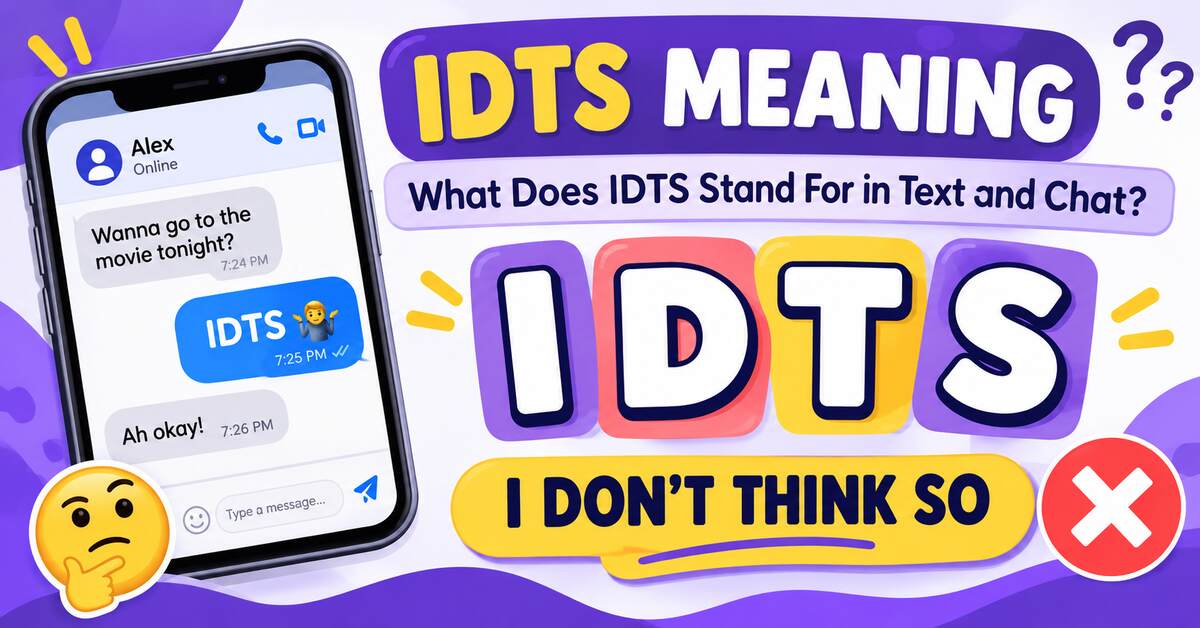
A friend just texted you “IDTS” and you’re staring at the screen. Relax. You haven’t missed a secret code.
IDTS means “I don’t think so.” People use this texting abbreviation to show doubt, politely disagree, or hint that something probably won’t happen. This guide explains how to read it, how to answer it, and whether it means anything in medicine, business, or the military.
Quick Answer: IDTS Meaning at a Glance
| Detail | Answer |
|---|---|
| Abbreviation | IDTS |
| Full form | I don’t think so |
| Type | Initialism (chat slang) |
| Main meaning | Doubt, mild disagreement, or a probable “no” |
| Tone | Neutral, casual, sometimes playful |
| Where you’ll see it | Text messages, DMs, group chats, comment sections |
| Safe at work? | Only with close colleagues in casual chats |
What Does IDTS Stand For in Texting?

Every letter in IDTS matches one word in the phrase. That’s how an initialism works.
| Letter | Word |
|---|---|
| I | I |
| D | Don’t |
| T | Think |
| S | So |
Here’s a small fact that explains the appeal. “I don’t think so” takes 16 characters to type, spaces included. IDTS takes 4. That saves 12 keystrokes on every reply, which adds up fast during a busy group chat.
Strictly speaking, IDTS is an initialism and not an acronym. Nobody pronounces it as a single word the way people say “NASA.” Most people read the letters aloud or simply think the full phrase. Still, many slang sites call it an acronym, and you’ll see both labels online.
Quick tip: IDTS usually lives in writing. You’ll rarely hear someone say “eye-dee-tee-ess” out loud.
IDTS Meaning in Text: How to Read It Based on the Question
The same four letters can carry different weight. The question that comes before IDTS decides what it means.
| Question type | Example question | What IDTS means |
|---|---|---|
| Prediction | “Will it rain tomorrow?” | Probably not |
| Opinion | “Isn’t this the best movie ever?” | I disagree |
| Invitation | “Are you coming tonight?” | I probably can’t |
| Fact check | “Did she finish already?” | I doubt it |
Linguists call this context-dependent meaning. The words alone don’t tell the whole story. The surrounding conversation fills in the rest.
Expressing Doubt
Sometimes IDTS means the sender isn’t sure. They lean toward no but can’t prove it.
A: Do you think Sara finished the assignment?
B: IDTS. She was still working on it yesterday.
Here the sender shows uncertainty and backs it with a reason. That reason matters. It tells you the doubt comes from evidence and not a hunch.
Disagreeing Without Starting a Fight
IDTS works as polite disagreement. It softens the negative opinion so it lands gently.
A: That’s definitely the best album this year.
B: IDTS, the second half dragged.
Compare that with “No, it wasn’t.” The IDTS version feels lighter because it leaves room for the other person’s view.
Giving a Quick Negative Answer
Sometimes a reason isn’t needed. A short quick negative answer does the job.
A: Will the teacher cancel class tomorrow?
B: IDTS.
The sender expects the opposite outcome. That’s a negative expectation, and three letters say it all.
IDTS vs. “No”: What’s the Difference?
Both words reject an idea. However, they don’t feel the same.
A flat “no” closes the door. IDTS leaves it slightly open. Linguists call that hedging. The speaker softens a claim so it sounds less absolute. It also reflects epistemic stance, which describes how sure a person feels about what they say.
| Feature | “No” | IDTS |
|---|---|---|
| Certainty | High | Medium |
| Tone | Direct, final | Softer, more open |
| Invites discussion? | Rarely | Often |
| Risk of sounding blunt | Higher | Lower |
Consider this pair:
- “No.” The decision is made.
- “IDTS, but let me check.” The sender might change their answer.
Spot the difference? IDTS says “my answer is probably no.” It doesn’t say “my answer is definitely no.”
No IDTS and Nah IDTS Meaning: Why People Stack Words
Many people search for “no idts meaning” and “nah idts meaning.” Both phrases confuse readers at first. After all, “no” plus “I don’t think so” sounds like a double negative.
It isn’t. Texters stack these words for emphasis. They don’t cancel each other out.
| Message | What it really means | Strength |
|---|---|---|
| IDTS | I don’t think so | Soft no |
| No, IDTS | No, I really don’t think so | Firm no |
| Nah IDTS | Nah, I doubt it (casual) | Relaxed but clear no |
| IDTS lol | I don’t think so (and I’m amused) | Light, playful no |
| IDTS tho | I don’t think so, though | Soft no with a small caveat |
Think of it like adding volume. “No” plus IDTS turns a polite doubt into a clear refusal. “Nah” adds a relaxed, informal register.
IDTS Meaning in Text Funny: How Tone Changes the Message

The abbreviation itself carries no emotion. Instead, tone comes from the extra signals around it. Those include emojis, punctuation, wording, and your relationship with the sender.
In person, your voice and face do this work. Linguists call those paralinguistic cues. Text strips them out. Therefore, people add emojis and punctuation to fill the gap.
| Tone | Signal to look for | Example |
|---|---|---|
| Funny | Laughing emoji, silly question | “Will I be a millionaire tomorrow?” “IDTS 😂” |
| Sarcastic | A jab or “unless…” clause | “IDTS, unless you own a time machine.” |
| Playful | Smirk emoji, teasing setup | “Can I beat you at this game?” “IDTS 😏” |
| Serious | A reason with no emoji | “IDTS. The manager confirmed the schedule.” |
| Flirty | Wink or smirk after a compliment question | “Do I look cute?” “IDTS 😏 You look amazing.” |
The flirty example works as a setup and punchline. The sender starts with what looks like a negative. Then the follow-up flips it into a compliment. Without that second line, the reader would assume a real “no.”
Sarcasm Needs Extra Care
Sarcasm is hard to catch in text. A message like “IDTS” after “Do you think I’ll finish in ten minutes?” could sound honest or mocking. Look at the sender’s usual style. If they joke often, assume humor first.
IDTS Meaning on Instagram, TikTok, and Other Platforms
The meaning stays the same everywhere. Still, each platform shapes how people use it.
| Platform | Typical setting | How IDTS shows up |
|---|---|---|
| SMS and iMessage | One-on-one chats | Direct replies to a question |
| Personal and group chats | Answers to plans and suggestions | |
| DMs and story replies | Quick reactions to a friend’s post or poll | |
| TikTok | Comments and DMs | Short replies to a creator’s claim or question |
| Snapchat | Fast chats | Rapid, casual answers, often lowercase |
| Discord | Servers and DMs | Replies in fast-moving conversations |
On short-form video apps, comment space is tight and replies happen fast. Abbreviations like IDTS fit that rhythm. A viewer who disagrees with a claim in a video can answer in four letters instead of a paragraph.
Group Chat vs. Private Text
In a private text, IDTS usually answers one person directly. In a group chat, it often reacts to a plan or suggestion. Other members may then jump in with different views. The meaning doesn’t change. Only the audience does.
Does IDTS Mean Something in Medical, Business, or Military Settings?
Many people search “idts meaning medical,” “idts meaning in business,” and “idts meaning military.” The honest answer is that texting dominates. However, acronym directories list a few technical expansions. Here’s what they show and how much you should trust each one.
IDTS Meaning Military
Acronym24’s military page lists Integrated Digital Telecommunications System as the most common expansion. It also shows Integrated Data Transport System and Integrated Development Test Schedule. These come from a public directory and not from an official defense glossary. Treat them as possibilities and not confirmed standards.
IDTS Meaning Medical
One low-quality page claims IDTS means infectious diseases transition service in healthcare. No hospital, journal, or health system source backs that claim. A related term does exist in engineering. Wikipedia’s IDT page describes an interdigital transducer as a sensor and transmitter for surface acoustic waves. IDTS could simply be its plural. That connection is an inference and not a documented standard.
IDTS Meaning in Business
No standard business expansion turned up in any directory or reference I checked. The general Acronym24 IDTS page also lists technical entries such as Instrumentation Data Transmission System and Independent Drive Tests. These look like industry-specific jargon, not mainstream business terms.
How to Decide Which Meaning Applies
| Where you saw IDTS | Most likely meaning |
|---|---|
| Text, DM, or chat from a friend | I don’t think so |
| Social media comment | I don’t think so |
| Engineering or telecom document | A technical system (check the document’s glossary) |
| Military or defense paperwork | Verify against the source’s own acronym list |
Rule of thumb: If the message sounds like a person answering a question, it means “I don’t think so.” If it sits inside a technical document, look for a definitions page.
How to Reply When Someone Texts IDTS

Your best reply depends on what you want next. Do you want a reason, a confirmation, or a joke?
| Your goal | Reply |
|---|---|
| Find out why | “Why not?” |
| Confirm it’s a no | “So that’s a no?” |
| Keep it light | “We’ll see 😄” |
| Accept it | “Okay, no worries.” |
| Change their mind | “What if I [offer or change]?” |
| Stay flirty | “Oh really? Let me change your mind 😉” |
If the answer feels unclear, ask. A quick follow-up question beats assuming the sender is annoyed. Remember that IDTS is hedged by design. The sender may welcome more information.
Is IDTS Rude?
No. IDTS is an informal abbreviation of an everyday phrase. It carries no insult.
However, a bare “IDTS” can feel curt in some moments. Imagine asking a friend, “Do you think I’ll get the job?” and getting “IDTS.” That stings. The abbreviation isn’t rude, but the missing explanation is.
| Blunt version | Softer version |
|---|---|
| “IDTS” | “IDTS, but I could be wrong” |
| “IDTS” | “IDTS, the forecast looks rough” |
| “IDTS” | “IDTS, here’s why…” |
In professional chats, spell it out. Write “I don’t think so, because…” to your manager or a client. The full phrase sounds clearer and more respectful. It also avoids confusion for anyone unfamiliar with chat slang.
IDTS vs. IDK, IDT, IDC, and Other Texting Abbreviations

IDTS looks like several other abbreviations. Mixing them up changes your whole message.
| Term | Meaning | What the sender is telling you |
|---|---|---|
| IDTS | I don’t think so | I lean toward no |
| IDT | I don’t think | Same idea, shorter, often followed by a clause |
| IDK | I don’t know | I have no answer |
| IDC | I don’t care | I have no preference |
| IMO | In my opinion | I’m sharing a view |
| TBH | To be honest | I’m about to be direct |
| IKR | I know, right? | I agree with you |
The biggest trap is IDTS vs. IDK. They differ in a simple way:
- IDTS says the sender holds an opinion. The answer leans negative.
- IDK says the sender holds no answer at all.
For example, “Is the store open?” followed by “IDK” means the sender can’t tell. “IDTS” means the sender believes it’s closed.
IDTS Capitalization, Spelling, and the Idtd Typo
You’ll see three common forms: IDTS, idts, and Idts. All mean the same thing. Lowercase feels casual and relaxed. Uppercase can feel more emphatic. Neither version changes the definition.
What About “Idtd”?
“Idtd” looks like a typo of IDTS. The D and S sit close together on a standard keyboard. Nobody has established it as a texting abbreviation. However, IDTD does appear in technical writing. One arXiv paper uses it for a machine-learning method called Information Diversification and Temporal Densification. If you’re reading a research paper, that’s likely what it means. In a text message, assume a slip of the thumb.
Where Did IDTS Come From?
Nobody has documented a creator, a first-use date, or an original platform for IDTS. Slang like this usually spreads through repeated use and not through a single announcement.
What we do know is the pattern. English speakers have long shortened common phrases into initials. Think of IDK, IMO, TBH, and BRB. IDTS follows the same recipe. It takes a phrase people say constantly and trims it to the first letter of each word.
Three forces drive this kind of shorthand:
- Speed: Typing four letters beats typing sixteen characters.
- Habit: Fast thumb-typing rewards short forms.
- Tone: Abbreviations feel casual and friendly.
Frequently Asked Questions About IDTS Meaning
What does IDTS mean in text?
IDTS means “I don’t think so.” Texters use it to show doubt, disagree gently, or predict that something won’t happen. The question before it shapes the exact meaning.
Is IDTS the same as IDK?
No. IDTS means “I don’t think so,” which leans negative. IDK means “I don’t know,” which signals no answer at all. Swapping them changes your message completely.
What does “no IDTS” or “nah IDTS” mean?
Both add emphasis. Stacking “no” or “nah” with IDTS makes the refusal firmer. It doesn’t create a double negative that flips the meaning.
Does IDTS mean something in medicine or the military?
Directories list technical expansions like Integrated Digital Telecommunications System for military use. Medical and business uses lack reliable sources. In text and chat, “I don’t think so” is the meaning.
Is it rude to reply with just IDTS?
Not usually. Between friends, it’s a normal quick answer. However, it can feel cold during serious or emotional talks. Add a reason to keep the tone kind.
What should I say back to IDTS?
Match your goal. Ask “Why not?” for details, “So that’s a no?” for clarity, or “Okay, no worries” to accept. Playful chats welcome a joke.
Can I use IDTS in a work message?
Only with colleagues you chat with casually. For managers, clients, or formal threads, write “I don’t think so” in full. It reads clearer and more professional.
Final Thoughts on IDTS Meaning
IDTS means “I don’t think so.” It’s a soft, hedged no that fits fast, casual chats. Its power comes from context. The question, the tone, the emojis, and your history with the sender all shape how it lands.
Keep these points in mind:
- IDTS leans negative. It signals doubt or disagreement.
- IDK means something else. Don’t confuse the two.
- Stacked words add force. “No IDTS” is firmer than IDTS alone.
- Technical meanings exist but stay rare. Check the source before assuming.
- Add a reason when it matters. A short explanation prevents hurt feelings.
- Spell it out at work. Clear writing beats shortcuts in professional settings.

Eddie Brock is an experienced blogger and the creative voice behind Phrase Nook. With a passion for words, ideas, and engaging storytelling, he brings thoughtful perspectives and practical insights to every post. Eddie enjoys exploring diverse topics, connecting with readers, and turning everyday experiences into meaningful stories. His writing aims to inform, inspire, and keep readers coming back for more.