
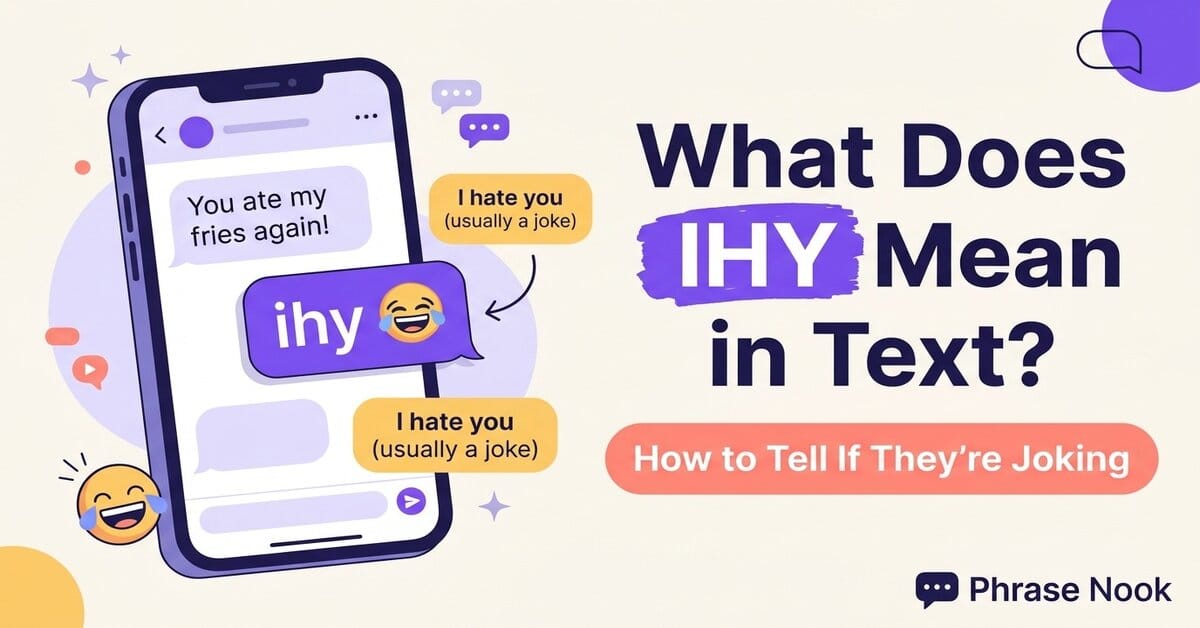
You’re scrolling through your phone. A message pops up. It says “ihy.” Your stomach drops for a second. Did you mess up? Is your friend upset? Or is this just a joke?
Take a breath. In most cases, IHY means “I hate you” and the sender doesn’t mean it. It’s a dramatic, playful way to react to something funny, embarrassing, or annoying. Still, the same three letters can sting when the mood is tense. That’s why context matters more than the acronym itself.
This guide explains what IHY means in text, how to read its tone, and what to say back. You’ll also see real examples, platform differences, and a few lookalike terms that confuse people.
Quick answer: IHY stands for “I hate you.” Friends mostly use it as hyperbole to tease or show playful jealousy. Check the emojis, punctuation, and your relationship with the sender to know if it’s a joke or a real complaint.
IHY Meaning: The Short Answer

Let’s start with the basics. IHY is text abbreviation slang. It belongs to the same family as ILY, JK, and SMH. People type it fast and casually in chats, comments, and captions.
What IHY Stands For in Text
IHY means “I hate you.” That’s the literal meaning. The intended meaning is usually very different.
Think about how people talk out loud. A friend steals the last fry and you say “I hate you.” You’re smiling when you say it. Nobody thinks you mean it. IHY works the same way, except the smile is missing. That missing smile is the whole problem.
Why People Say “I Hate You” When They Don’t Mean It
Linguists call this the gap between literal and intended meaning pragmatics. We say one thing and mean another all the time. “You’re killing me” doesn’t involve any crime. “I’m dying” doesn’t involve any funeral.
IHY follows the same pattern. It’s emotional exaggeration that shows closeness. You can only tease someone this hard if you trust them. Strangers rarely use it for that reason.
People also use IHY to:
- Joke with close friends
- Show fake anger after a prank
- Express playful jealousy
- React dramatically to a compliment or good news
- Show embarrassment in a funny way
IHY Meaning at a Glance
| Detail | What to Know |
|---|---|
| Full form | I hate you |
| Type | Internet slang and texting slang |
| Common tone | Playful, sarcastic, dramatic |
| Can it be serious? | Yes, during conflict or without a softener |
| Formality | Informal only |
| Opposite | ILY (I love you) |
| Typical users | Friends, partners, social media commenters |
What Does IHY Mean on Instagram, Snapchat, WhatsApp, and TikTok?

The core meaning stays the same on every app. The vibe changes a little though. Each platform has its own habits.
IHY Meaning on Instagram
On Instagram, IHY shows up in comments under photos and Reels. It often signals jealous admiration.
For example, someone posts a beach vacation photo. A friend comments “ihy 😭.” Translation: “I’m jealous and I wish I were there.” The crying emoji adds the dramatic flavor.
You’ll also see it in DMs. A friend sends you a meme about your own bad habit and you reply “ihy.” That’s pure teasing.
IHY Meaning on Snapchat
Snapchat moves fast. People often send a quick reaction snap after something funny or embarrassing. IHY works well here because the photo or video usually shows a laughing face. The visual does the tone work for you.
That also means a plain-text “ihy” on Snapchat deserves a closer look. Without a face, it can feel colder.
IHY Meaning on WhatsApp
WhatsApp chats tend to be longer and more personal. Group chats and family threads live here. IHY appears mostly between close friends.
A typical message: “You didn’t invite me? ihy 😂.” The sender isn’t angry. They’re pretending to be offended.
Keep an eye on chat history though. WhatsApp keeps every message in one scroll. If the last few messages felt tense, a new IHY may carry that tension.
IHY Meaning on TikTok
TikTok turns everything into a performance. IHY appears in comment sections and captions with a theatrical flavor. Creators and fans use it when a video hits too close to home.
Imagine a video about people who never reply to texts. A viewer comments “ihy 💀.” They mean “you just called me out.” It’s meme culture at work.
Platform Comparison
| Platform | Where IHY Appears | Usual Meaning |
|---|---|---|
| Comments, Reels, DMs | Jealous admiration or teasing | |
| Snapchat | Reaction snaps, chats | Funny annoyance |
| Friend and group chats | Playful complaint | |
| TikTok | Comments, captions | Dramatic reaction to relatable content |
IHY Meaning From a Girl vs. From a Guy
Many people search for “ihy meaning from a girl” or “ihy meaning in text from a guy.” They want to know if gender changes the message.
Here’s the honest answer. It doesn’t change the words. IHY still means “I hate you.” What changes is the relationship and the situation.
What Does IHY Mean From a Girl?
A girl texting IHY to a friend usually means one of these:
- Playful: She’s teasing you after a joke.
- Jealous: She’s reacting to your good news.
- Flirty: She’s flustered after a compliment.
- Dramatic: She’s exaggerating for fun.
The flirty version surprises people. Picture this: you text, “You look great today.” She replies “ihy 😭.” She isn’t angry. She’s overwhelmed in a cute way.
What Does IHY Mean in Text From a Guy?
A guy sending IHY often means:
- Joking: He’s roasting you.
- Sarcastic: He’s reacting to a bad pun or a spoiler.
- Annoyed: He’s mildly bothered but not furious.
- Serious: Rare but possible during an argument.
Guys also tend to pair it with “bro” or “lol.” Those filler words soften the phrase.
Side-by-Side View
| Factor | From a Girl | From a Guy |
|---|---|---|
| Meaning | I hate you | I hate you |
| Most common tone | Playful, flirty, dramatic | Joking, sarcastic |
| Typical softeners | 😭 😂 “omg” | 😂 “lol” “bro” |
| When to worry | No emoji plus a cold tone | No emoji plus a cold tone |
| Best clue | Relationship and last messages | Relationship and last messages |
Don’t judge by gender. Judge by the conversation.
Is IHY Joking or Serious? The Tone Decoder

Text has no voice. You can’t hear a laugh or see a smirk. Researchers and everyday users call the missing signals paralinguistic cues. Emojis, capitalization, and punctuation try to fill that gap.
So how do you read IHY correctly? Use these clues.
Tone Signals Table
| Signal | Likely Joking | Likely Serious |
|---|---|---|
| Emoji | 😂 😭 💀 😅 | None at all |
| Capitalization | ihy (lowercase, soft) | IHY (louder) |
| Punctuation | “ihy omg” | “IHY.” with a period |
| Filler words | omg, lol, bro | None |
| Repetition | “ihy ihy ihy” | A single cold “IHY” |
| Timing | Right after a funny moment | Right after a fight |
| Follow-up | Quick laugh or meme | Silence or a short reply |
A period at the end of a casual text is a classic tone indicator. “ihy” feels light. “IHY.” feels like a closed door.
The 10-Second Check
Ask yourself three questions before you react:
- What did I just say or do? If it was funny or teasing, the answer is probably a joke.
- What’s our history? Close friends use it playfully. New contacts are harder to read.
- Did they soften it? An emoji or a “lol” usually means they’re kidding.
Most of the time, these three questions solve the puzzle.
Red Flags That IHY Is Serious
Sometimes the message is real. Watch for these signs:
- It follows an argument or an awkward silence
- The sender uses a cold tone with no emoji
- The text includes more negative words, like “Don’t text me again”
- Their other replies have become short and flat
- You’ve heard similar complaints from them recently
Compare these two messages:
“ihy 😂 you ate my fries again”
“IHY. Don’t text me again.”
The first one is banter. The second one is real anger. Nobody needs a decoder for that second message.
IHY Meaning in Text: Real Scenarios, Message by Message

Rules are helpful. Real examples are better. Here are four common situations with a quick read on each.
Scenario One: The Spoiler
You tell your friend how a show ends. They reply:
“ihy 😭”
Read: Joking. The crying emoji shows dramatic frustration. They’re annoyed at the spoiler but they aren’t annoyed at you.
Scenario Two: The Canceled Plans
You cancel dinner at the last minute. Your partner replies:
“IHY.”
Read: Possibly hurt. There’s no emoji and a period closes the message. The caps lock adds weight. This is a moment to check in, not to joke back.
Scenario Three: The Compliment
You tell your crush, “That outfit looks amazing.” They answer:
“ihy omg”
Read: Flustered or flirty. “Omg” signals excitement. Lowercase keeps it soft. They like the compliment.
Scenario Four: The Argument
You and a friend have been trading sharp texts for ten minutes. They send:
“IHY”
Read: Serious. The context is tense. Treat it as a real signal and respond with care.
What These Scenarios Teach
| Scenario | Key Clue | Verdict |
|---|---|---|
| Spoiler | 😭 emoji | Joking |
| Canceled plans | Period and caps | Possibly hurt |
| Compliment | “omg” and lowercase | Flirty |
| Argument | Tense context | Serious |
The word is identical in every case. The surrounding messages do all the work.
How to Reply When Someone Texts “IHY”

Your reply should match the sender intent. A mismatched reply creates misunderstanding fast. A joke answered with anger can start a real fight.
Playful Replies for Jokes
When the message feels light, play along:
- “Rude 😂”
- “Stay jealous 😎”
- “You’ll survive”
- “You still love me though”
Keep it short. Banter works best when it’s quick.
Replies When You’re Unsure
Ambiguity is normal in text. Asking a simple question is fine.
- “Wait, joking or mad?”
- “Hard to tell over text 😅”
- “Are you serious right now?”
This approach saves time. A quick clarification beats an hour of overthinking.
Replies When It Seems Serious
If the tone looks real, drop the jokes:
- “Did I do something wrong?”
- “Hey, can we talk about it?”
- “That sounded upset. Are you okay?”
A calm reply lowers the temperature. It also shows you care.
Replies to Set a Boundary
Some people don’t enjoy this kind of teasing. You can say so politely:
- “That one stung a little.”
- “Can we skip that joke?”
- “Please don’t say that to me.”
You have every right to protect your comfort.
Reply Guide by Relationship
| Relationship | Best Reply Style | Example |
|---|---|---|
| Close friend | Banter | “Rude 😂” |
| Partner | Warm and teasing | “You love me though 😘” |
| Crush | Light and flirty | “Is that a compliment? 😏” |
| Family member | Gentle check-in | “Haha what did I do?” |
| Someone upset | Calm and direct | “Are you okay?” |
IHY Variations: IHYSM, IHYK, and Lookalikes
People often search for similar-looking terms. Some are real variants. Others are totally different slang. Let’s sort them out.
IHYSM
IHYSM stands for “I hate you so much.” It’s the intensified version of IHY. The “so much” adds drama. Friends use it when they want to exaggerate even more.
Example: “You got front-row tickets?? ihysm 😭”
The tone stays playful in almost every case.
IHYK
Here things get tricky. IHYK is not a longer version of IHY. Online explanations disagree on what it means. Some say “I hope you know.” Others say “if you knew.” Because of this ambiguity, read the full message before you decide.
Example: “Love you guys, ihyk.” In that sentence, “I hope you know” fits best.
LHY
Some people search “lhy meaning in chat.” This is most likely a typo. A lowercase “L” and a capital “I” look nearly identical in many fonts. If you see LHY, the sender probably meant IHY.
Quick Variation Table
| Term | Likely Meaning | Notes |
|---|---|---|
| IHY | I hate you | The standard form |
| IHYSM | I hate you so much | Stronger, still playful |
| IHYK | Ambiguous | Often “I hope you know” |
| LHY | Probably a typo | Font lookalike |
Always check the context with these. Short acronyms collide often.
IHY vs. ILY, JK, and SMH
IHY lives in a crowded neighborhood of internet slang. These comparisons clear up the confusion.
IHY vs. ILY
ILY means “I love you.” IHY means “I hate you.” One letter separates them but they point in opposite directions.
Some people combine both in one message. “Ihy but ily” is a common pattern. It shows affection and annoyance at the same time. It’s the clearest proof that IHY isn’t about real hate.
IHY vs. JK
JK means “just kidding.” It labels a message as humor. IHY doesn’t label itself. That’s why people add “jk” after IHY when the joke might land badly.
Example: “ihy jk 😂”
IHY vs. SMH
SMH means “shaking my head.” It shows disbelief or disappointment. It’s cooler and more detached. IHY is more emotional and aimed at a person.
Comparison Table
| Slang | Meaning | Emotional Style | Aimed At |
|---|---|---|---|
| IHY | I hate you | Dramatic, playful | A person |
| ILY | I love you | Warm, sincere | A person |
| JK | Just kidding | Light, clarifying | The previous message |
| SMH | Shaking my head | Disappointed, flat | A situation |
When Not to Use IHY in Text
IHY works best among friends who know each other’s tone. Outside that circle, it gets risky. Skip it in these cases:
- Work chats and emails. The register is too casual and it sounds rude.
- Early dating. The other person can’t read your humor yet.
- Active arguments. It can sound like a real attack.
- Strangers and new contacts. They have no context.
- People who take words literally. Some readers don’t pick up sarcasm in text.
- Emotional moments. Someone who’s sad may hear it differently.
Here’s a simple rule. If you wouldn’t say “I hate you” out loud with a grin, don’t type it.
What to Use Instead
If you want a safer way to show playful annoyance, try these:
- “You’re so annoying 😂”
- “Wow, rude”
- “I can’t believe you did that”
- “Okay, that was funny”
They deliver the same energy with less risk.
Other Meanings of IHY
IHY isn’t only slang. Two other meanings exist. Neither one will show up in your chat, but it helps to know them.
Ihy, the Egyptian God
In ancient Egyptian mythology, Ihy was a child god linked to music and joy. He was the son of the goddess Hathor. Artists often showed him with a sistrum, a rattle-like instrument used in ceremonies.
That’s why people searching “ihy god” land on mythology pages instead of slang guides.
International Heliophysical Year
IHY also stands for International Heliophysical Year, a worldwide science program from 2007. It focused on studying the Sun and its effect on space and Earth. The event marked 50 years since an earlier global geophysical research effort.
Neither meaning applies to texting. If your friend sends “ihy 😂,” they aren’t talking about pharaohs or solar physics.
FAQs About What IHY Means
What does IHY mean in text?
It means “I hate you.” In most texts, it’s a joke. Friends use it to tease or react dramatically.
Is IHY serious or joking?
Usually joking. Check the emojis, punctuation, and recent messages. A cold tone with no emoji can signal real anger.
Is IHY rude?
Not between close friends. It can feel rude with strangers, at work, or during an argument.
What does IHY 😂 mean?
It means the sender is joking. The laughing emoji shows humor and softens the phrase.
What does IHY mean from a girl?
It still means “I hate you.” The tone depends on the relationship. It may be playful, flirty, or dramatic.
Is IHY the same as ILY?
No. IHY means “I hate you.” ILY means “I love you.” They’re opposites.
What does IHYSM mean?
IHYSM means “I hate you so much.” It’s a stronger and more dramatic version of IHY.
Should I use IHY at work?
No. It sounds unprofessional and people can misread it easily.
Conclusion
So, what does IHY mean in text? On paper, it means “I hate you.” In real life, it usually means “you got me,” “that was funny,” or “I’m a little jealous.” The phrase works through hyperbole, sarcasm, and the shared context between people who know each other well. Close friends can say something harsh and both of them hear affection underneath.
Still, the words alone never tell the whole story. Text strips away voice, facial expression, and body language. That’s why a single “ihy” can feel like a joke in one chat and a slap in another. The letters don’t change. The tone, the timing, and the relationship do.

Eddie Brock is an experienced blogger and the creative voice behind Phrase Nook. With a passion for words, ideas, and engaging storytelling, he brings thoughtful perspectives and practical insights to every post. Eddie enjoys exploring diverse topics, connecting with readers, and turning everyday experiences into meaningful stories. His writing aims to inform, inspire, and keep readers coming back for more.