
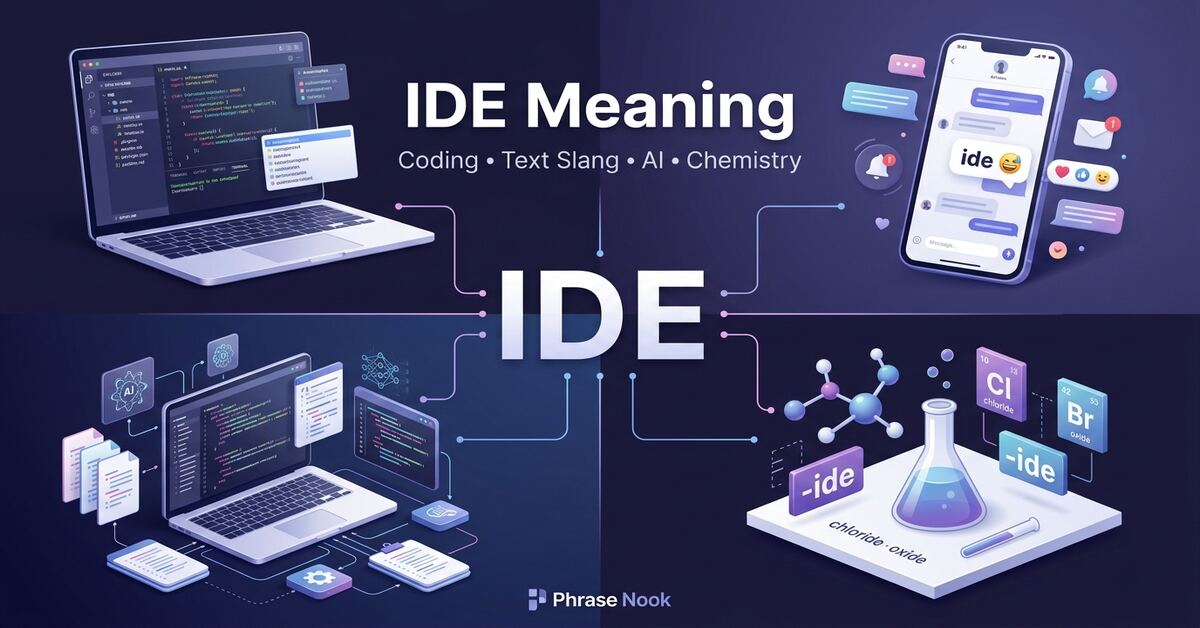
Type “IDE” into a search bar and you’ll get answers from four different worlds. A programmer sees software. A teenager sees a text reaction. A chemistry student sees a word ending. Someone with an old desktop computer might see a cable.
IDE most often means Integrated Development Environment, a program developers use to write, test, and fix code. In texting, it’s sometimes a shortened “I don’t even.” In chemistry, “-ide” is a naming suffix. This guide explains each meaning, shows how to tell them apart, and covers newer terms like AI IDE and agentic IDE.
Quick Answer: What Does IDE Mean?
The short version depends on where you found the term.
| Meaning | Field | Example | Where you’ll see it |
|---|---|---|---|
| Integrated Development Environment | Software development | “Open the project in your IDE.” | Coding tutorials, job listings, developer chats |
| I don’t even (informal) | Text slang | “He’s still texting her… ide.” | Comments, DMs, group chats |
| “-ide” suffix | Chemistry | Sodium chloride | Textbooks, lab reports, exams |
| Integrated Drive Electronics | Computer hardware | An IDE hard drive cable | Older PCs, hardware manuals |
Context decides almost everything. The surrounding words usually give the answer within a sentence.
IDE Meaning in Coding and Programming

In programming, an IDE is a single application that bundles the tools a developer needs. If you’ve searched for the ide meaning in coding, ide meaning programming, or ide meaning software, this is almost certainly what you’re after.
What Is an IDE?
An Integrated Development Environment combines writing, running, and debugging code in one window. The word “integrated” is the key. Instead of juggling a separate text editor, a command-line compiler, and a debugging tool, a developer gets them working together.
Think of it like a kitchen versus a pile of ingredients. You can cook with a knife, a pan, and a stove scattered across the house. An IDE puts everything within arm’s reach and makes the pieces aware of each other.
What an IDE Includes
Features vary by product and language, but most IDEs share a core set of tools:
- Code editor: a text editor built for source code, with line numbers and file navigation.
- Syntax highlighting: colors that separate keywords, variables, and strings so mistakes stand out.
- Autocomplete: suggestions for function names and variables as you type.
- Compiler or interpreter: the tool that turns code into a running program (or runs it directly).
- Debugger: lets you pause a program, step through it line by line, and inspect values.
- Build tools: automate packaging, testing, and running the project.
- Version control integration: commit, compare, and merge code (typically Git) without leaving the window.
- Plugins or extensions: add support for new languages, themes, and tools.
How an IDE Works in Practice
Picture a developer building a small web app. They open the project folder and start typing. The IDE flags a misspelled variable before the code even runs. They press a button to launch the app, and it crashes. Instead of reading a wall of error text, they click the error, land on the exact line, and set a breakpoint to watch what’s happening. Once it works, they commit the change to Git from a side panel.
That whole loop of writing, running, debugging, and saving happens in one place. That’s the practical value of an IDE.
IDE vs. Text Editor
The line between the two has blurred, but the core difference still holds.
| Feature | Text editor | IDE |
|---|---|---|
| Main purpose | Editing text and code quickly | Building entire software projects |
| Debugger | Usually not built in | Built in |
| Code analysis | Basic or added by plugins | Deep, language-aware |
| Weight | Lightweight, fast to open | Heavier, slower to start |
| Setup | Minimal | Often requires project configuration |
| Examples | Notepad++, Vim, Sublime Text | IntelliJ IDEA, Visual Studio, PyCharm |
Visual Studio Code sits in the gray zone. Out of the box it behaves like an editor, but with extensions it gains IDE-level features. Microsoft describes it as a code editor, yet developers routinely use it as their IDE. Stack Overflow’s survey even lists it among “IDEs,” which tells you how fuzzy the category has become.
Popular IDE Examples
The Stack Overflow 2025 Developer Survey gives a useful snapshot of what developers actually use. Among all respondents:
- Visual Studio Code: 75.9%
- Visual Studio: 29%
- Notepad++: 27.4%
- IntelliJ IDEA: 27.1%
- Vim: 24.3%
Developers often use more than one tool, so these figures add up to well over 100%. Other widely used options include PyCharm (Python), Eclipse (Java and other languages), Xcode (Apple platforms), and Android Studio (Android apps).
Language matters too. JetBrains builds separate IDEs for different languages, which is why IntelliJ IDEA is a common pick for Java while PyCharm targets Python.
Who Uses IDEs and Why
Professional software developers use IDEs for speed. Automatic error detection and quick navigation across thousands of files save hours. Students use them because the tools catch beginner mistakes early and make debugging visible. Teams benefit from shared setups, so everyone builds and tests code the same way.
The trade-off is weight. A full IDE can take longer to launch and demand more memory. For a quick edit to one file, many developers still reach for a lighter editor.
AI IDE Meaning and Agentic IDE Meaning

Two newer phrases now show up in search results: AI IDE meaning and agentic IDE meaning. They describe how AI has changed the category. Because this area moves fast, the details below reflect information available as of September 2026.
What Is an AI IDE?
An AI IDE is an IDE with artificial intelligence built into the editing experience. It can suggest whole lines or functions, answer questions about your code in a chat panel, explain errors, and help rewrite (refactor) messy sections. The AI sees your project files, so its suggestions fit your code rather than generic examples.
What Is an Agentic IDE?
An agentic IDE goes a step further. Instead of suggesting the next line, AI agents take on multi-step tasks. You describe a goal, such as “add a login page with email validation.” The agent plans the work, edits several files, runs terminal commands, tests the result, and fixes errors it finds along the way. Your role shifts toward reviewing and directing rather than typing every line.
The difference in one sentence: autocomplete predicts; an agent acts.
AI IDE vs. Traditional IDE
| Aspect | Traditional IDE | AI or agentic IDE |
|---|---|---|
| Code writing | Developer writes; tool assists with syntax | AI drafts code from prompts |
| Scope of help | Current line or file | Whole project, multiple files |
| Task handling | Developer runs each step | Agent can plan and run steps |
| Developer’s role | Author | Author and reviewer |
| Main risk | Human error | Incorrect AI output that needs checking |
That last row matters. In the Stack Overflow 2025 survey, most respondents said they distrust AI answers, and only about 31% were using AI agents at the time, according to Visual Studio Magazine’s coverage. Reviewing AI-generated code remains part of the job.
Current Examples
Several products fall into this category as of September 2026:
- Cursor: an AI-first editor built on VS Code. It debuted in the Stack Overflow survey at 18% usage.
- Google Antigravity: an agent-focused IDE where you manage AI agents working on tasks.
- Kiro: Amazon’s spec-driven IDE, which organizes agent work around written requirements. Some 2026 roundups still describe it as a preview product.
- Windsurf: an agentic IDE that Cognition acquired. One July 2026 review reports it was rebranded Devin Desktop, so check the current name before choosing it.
- JetBrains Junie and GitHub Copilot agent mode: agent features added to established tools.
Product names, pricing, and ownership in this space change quickly, so confirm details on each vendor’s site before you commit to anything.
IDE Meaning in Text Slang

Now for the meaning behind most “ide meaning text” searches. If a friend sent you a message that just says “IDE,” here’s what it likely means.
IDE Means “I Don’t Even” in Texting
In casual messages, IDE is a shortened form of “I don’t even.” People use it when something leaves them stunned, amused, annoyed, or simply out of words. The phrase deliberately trails off, as if the feeling cut the sentence short.
Linguists call that kind of interrupted sentence an aposiopesis. The full thought might be “I don’t even know what to say,” but the speaker lets you fill in the rest.
Real Examples
Tone shifts with the situation, so here are three common uses:
- Amused: A friend sends a video of a dog riding a skateboard. You reply: “ide 😂”
- Shocked: Someone tells you a coworker quit by sending a meme. You reply: “The whole team saw it?? IDE.”
- Frustrated: “Third time this week he’s canceled on me. ide.”
Notice that the emoji and the context carry the feeling. The three letters alone don’t.
Where the Phrase Comes From
The phrase is older than many guides suggest. Know Your Meme traces “I don’t even” to a 2007 message board post, according to a Chronicle of Higher Education linguistics column. The closely related “I can’t even” appeared on Tumblr and Twitter by at least early 2009, per Dictionary.com’s slang entry, which notes that it got its own Urban Dictionary entry in July 2010.
It hit the mainstream around 2013 and 2014. Dictionary.com points to YouTuber Tyler Oakley’s 2012 use as a boost. On January 26, 2014, singer Kacey Musgraves repeated “I can’t even” in her Grammy acceptance speech for Best Country Album.
That timeline corrects a common claim. Competing articles say the phrase became popular in the “early 2010s,” which is true for mainstream use. The roots go back further.
How Established Is “IDE” as an Abbreviation?
Here’s the honest answer: the full phrase is well documented, but the three-letter form “IDE” is not.
I couldn’t find “IDE” listed as an established abbreviation in major slang dictionaries. “I don’t even” and “I can’t even” both have solid records. The shortened “IDE” appears to be a smaller, informal spin-off. Its meaning depends heavily on the group using it, and plenty of people will read it as the software term instead.
For comparison, “IDK” is universally understood. “IDEK” (I don’t even know) is more widely recognized than “IDE.” When you use “IDE” with someone new, expect a confused reply.
Other Slang Readings
Two other interpretations come up in casual chats:
- “Idea,” typed quickly: Phrases like “no ide” or “good ide” turn up in fast, informal typing. It’s a spelling shortcut rather than formal slang.
- A typo for IDK or IDEK: The letters E and K aren’t adjacent on most keyboards, but autocorrect and fast thumbs cause odd slips. If the sentence is about not knowing something, a typo is plausible.
Treat both as possibilities, not standard definitions.
Tone Cues
The same three letters can land very differently:
- “IDE 😂” usually signals amusement.
- “IDE.” with a period often reads as tired, flat, or fed up.
- “ide…” with an ellipsis suggests trailing off in disbelief.
- Lowercase “ide” feels casual. Capital “IDE” can feel louder or more dramatic, though that’s a habit, not a rule.
When unsure, reread the conversation. The mood of the last message usually tells you more than the letters do.
IDE Meaning in Text Slang on TikTok
On TikTok, the shortened form is mostly a reaction. Comment sections move fast, and three-letter replies fit the pace.
You’ll typically see it in a few patterns:
- Standalone: “IDE 😭” under a video that leaves viewers speechless.
- With a reason: “IDE the way he looked at the camera” (a common “the way…” comment style).
- Chain reactions: Several commenters repeat the same reaction under one popular comment.
In most cases, the commenter is amused or amazed, rather than upset. Emojis usually confirm which.
Two cautions apply. First, TikTok slang cycles quickly, so what’s common this month may fade. Second, avoid using it under serious or sad posts, where the joking tone could look careless.
IDE vs. IDK, IDEK, and Other Slang
“IDE” gets mixed up with its lookalikes constantly. This table keeps them straight.
| Abbreviation | Full form | Meaning | Tone |
|---|---|---|---|
| IDE | I don’t even | Speechless reaction | Shocked, amused, or annoyed |
| IDEK | I don’t even know | Totally confused | Overwhelmed |
| IDK | I don’t know | Simple uncertainty | Neutral |
| IDC | I don’t care | Indifference | Bored or dismissive |
| IDTS | I don’t think so | Polite disagreement | Mild doubt |
| IDR | I don’t remember | Memory blank | Neutral |
| IDT | I don’t think | Hesitation or doubt | Mild |
| SMH | Shaking my head | Disappointment | Disapproving |
| SMFH | Shaking my freaking head | Stronger disappointment | Frustrated |
| TBH | To be honest | Introduces an honest opinion | Casual |
| FWIW | For what it’s worth | Softens advice or opinion | Gentle |
| ICYMI | In case you missed it | Shares overlooked info | Informational |
| IYKYK | If you know, you know | Inside joke | Playful |
The closest relative is “I can’t even,” which carries the same speechless feeling and is far better documented. If you want to be understood by nearly everyone, use “I can’t even” in full. Save the abbreviation for friends who already use it.
When to Use IDE in Messages (and When Not To)
Slang works when everyone shares it. Here’s a quick guide to common settings.
| Setting | OK to use? | Why |
|---|---|---|
| Group chat with close friends | Yes | Shared slang, relaxed tone |
| Reacting on social media | Usually | Short, playful, widely accepted |
| Family chat | Maybe | Only if they know internet slang |
| Work email | No | Unprofessional and easy to misread |
| Message to a teacher or client | No | Formal settings need full sentences |
| Developer team chat | Avoid | “IDE” already means software there |
That last row is a real trap. In a developer channel, “IDE” means the software. Someone replying “ide 😂” to a bug report could cause genuine confusion. Write out “I don’t even” in that setting.
How to Respond When Someone Texts “IDE”
Match your reply to the sender’s mood. Read the emoji, the topic, and what they said just before.
| The sender seems | Best approach | Example reply |
|---|---|---|
| Amused | Join the joke | “Right? I can’t stop watching it.” |
| Shocked | Acknowledge it | “I know, I didn’t see that coming.” |
| Frustrated or upset | Offer support | “That sounds like a lot. Want to talk?” |
| Confused | Clarify | “Want me to explain what happened?” |
| Unclear | Ask gently | “Good ide or bad ide? 😄” |
If the message looks tired or flat, such as “ide.” after bad news, check in before joking. A short “Are you okay?” costs nothing and avoids an awkward misread.
IDE Meaning in Chemistry

Searchers looking for ide meaning chemistry usually want to know about the word ending “-ide,” not IDE as a standalone term.
The “-ide” Suffix
In chemical naming, -ide marks a simple negative ion (anion) made from a single element, and the binary compounds built from it. A binary compound contains just two elements. The element’s name gets shortened and “-ide” added, so chlorine becomes chloride and oxygen becomes oxide.
Examples Table
| Element | Anion name | Example compound |
|---|---|---|
| Chlorine | Chloride | Sodium chloride (NaCl), table salt |
| Oxygen | Oxide | Magnesium oxide (MgO) |
| Sulfur | Sulfide | Iron(II) sulfide (FeS) |
| Nitrogen | Nitride | Lithium nitride (Li₃N) |
| Hydrogen | Hydride | Sodium hydride (NaH) |
| Fluorine | Fluoride | Calcium fluoride (CaF₂) |
Exceptions to Note
Two common polyatomic ions also end in “-ide,” even though they contain more than one element: hydroxide (OH⁻) and cyanide (CN⁻). Other examples include azide (N₃⁻) and peroxide (O₂²⁻).
Also watch for lookalike endings. “-ate” and “-ite” usually signal oxygen-containing ions, such as sulfate and sulfite. Sulfide, with “-ide,” contains sulfur alone. Confusing them is a classic exam mistake.
Other Meanings of IDE
A few lesser-known meanings turn up in the bare “ide meaning” and “ide meaning in English” searches.
| Meaning | Field | Context |
|---|---|---|
| Integrated Drive Electronics | Computer hardware | An older standard for connecting hard drives and optical drives to a motherboard |
| Ide (fish) | Biology | A freshwater fish (Leuciscus idus), also called the orfe |
Integrated Drive Electronics refers to an interface that was standard in PCs for years. It’s now formally known as ATA, and the older version is often called PATA (Parallel ATA) to distinguish it from the newer SATA. If you see “IDE cable” in a hardware guide, it means the wide ribbon cable used in older desktops.
The ide is a European freshwater fish, better known in aquarium and angling circles as the orfe. You’ll mostly encounter this meaning in nature references or fishing writing.
How to Tell Which IDE Meaning You’re Looking At
Use the surrounding clues to decide quickly.
| Clue | Likely meaning |
|---|---|
| Mentions code, software, debugging, or a programming language | Integrated Development Environment |
| Mentions VS Code, PyCharm, IntelliJ, or Xcode | Integrated Development Environment |
| Reaction to news, a joke, or a video, often with an emoji | “I don’t even” |
| Appears in “no ide” or “good ide” | “Idea” |
| Part of a compound name like oxide or chloride | Chemistry suffix |
| Talks about hard drives, cables, or old PCs | Integrated Drive Electronics |
| Mentions AI agents, prompts, or automated coding | AI or agentic IDE |
If two clues conflict, ask the person. A quick “wait, which IDE?” beats a wrong guess.
FAQs
What does IDE mean?
IDE most commonly means Integrated Development Environment, a software application for writing and testing code. In texting, it can mean “I don’t even.” In chemistry, “-ide” is a naming suffix.
What does IDE stand for in coding?
It stands for Integrated Development Environment. It combines a code editor, debugger, build tools, and other features in a single program.
What does IDE mean in text slang?
It’s an informal shortening of “I don’t even,” used when something leaves you speechless. It’s less established than “IDK” or “IDEK,” so some readers may not recognize it.
What does IDE mean in text slang on TikTok?
On TikTok it typically works as a short reaction to a funny, shocking, or impressive video, often paired with an emoji.
Is an IDE the same as a code editor?
Not exactly. A code editor focuses on editing text. An IDE adds integrated tools such as a debugger and build system. Some editors, like VS Code, become IDE-like through extensions.
What is an AI IDE?
It’s an IDE with built-in AI that can suggest code, answer questions about your project, and help refactor it.
What is an agentic IDE?
It’s an IDE where AI agents can plan and carry out multi-step coding tasks, such as editing files and running commands, with the developer reviewing the results.
What does IDE mean in chemistry?
The suffix “-ide” names simple anions and binary compounds, like chloride and oxide. Hydroxide and cyanide are polyatomic exceptions.
Is IDE the same as IDK?
No. IDK means “I don’t know.” IDE (as slang) means “I don’t even,” a reaction rather than an admission of uncertainty.
Can I use IDE in professional messages?
Avoid it. Colleagues may not know the slang, and in technical teams it already means software.
What does IDE mean in Urban Dictionary?
Urban Dictionary entries are user-written, so definitions vary and aren’t verified. Treat them as examples of usage, not authoritative definitions.
Conclusion
The right answer to “what does IDE mean?” depends on where you saw it. In code or software talk, it’s an Integrated Development Environment, and newer AI and agentic versions are changing how developers work. In a playful text, it’s most likely “I don’t even,” a shortened form of a well-documented phrase whose three-letter version remains informal. Within chemistry, it’s the ending that turns chlorine into chloride.
When in doubt, check the clues: the topic, the emoji, the people involved. If the clues don’t settle it, asking takes five seconds. For the slang meaning especially, writing out “I can’t even” in full is the safest way to make sure everyone gets the joke.
Note on sources: Stack Overflow survey figures are from the 2025 survey. AI IDE product details reflect roundups published through July 2026 and may have changed since.
Conclusion
The meaning of “IDE” depends entirely on where you see it. In coding, it stands for Integrated Development Environment, the all-in-one workspace for writing, testing, and debugging code. Newer AI and agentic versions are now changing how developers work.
In texting and on TikTok, it usually means “I don’t even,” a reaction to something funny, shocking, or frustrating. It’s still informal and far less recognized than IDK or IDEK, so some people may not get it.
In chemistry, -ide is the suffix that gives us words like chloride and oxide. In older hardware guides, it can also mean Integrated Drive Electronics.

Eddie Brock is an experienced blogger and the creative voice behind Phrase Nook. With a passion for words, ideas, and engaging storytelling, he brings thoughtful perspectives and practical insights to every post. Eddie enjoys exploring diverse topics, connecting with readers, and turning everyday experiences into meaningful stories. His writing aims to inform, inspire, and keep readers coming back for more.